A useful rackable pallet quote starts before anyone talks about price. The supplier needs enough application detail to understand the pallet, load, rack, handling equipment, storage conditions, and approval path. Without that context, a quote can look complete while still leaving important compatibility questions unanswered.
This guide gives warehouse, procurement, operations, and safety teams a practical list of questions to prepare before requesting a rackable plastic pallet quote. It is written to help buyers compare options more carefully without treating any generic pallet label as a site-specific approval.
If you are still defining the basics, start with what makes a plastic pallet rackable. If you already have rack, load, and handling details, use the questions below to make the quote request more useful.
1. What exact pallet size do you need?
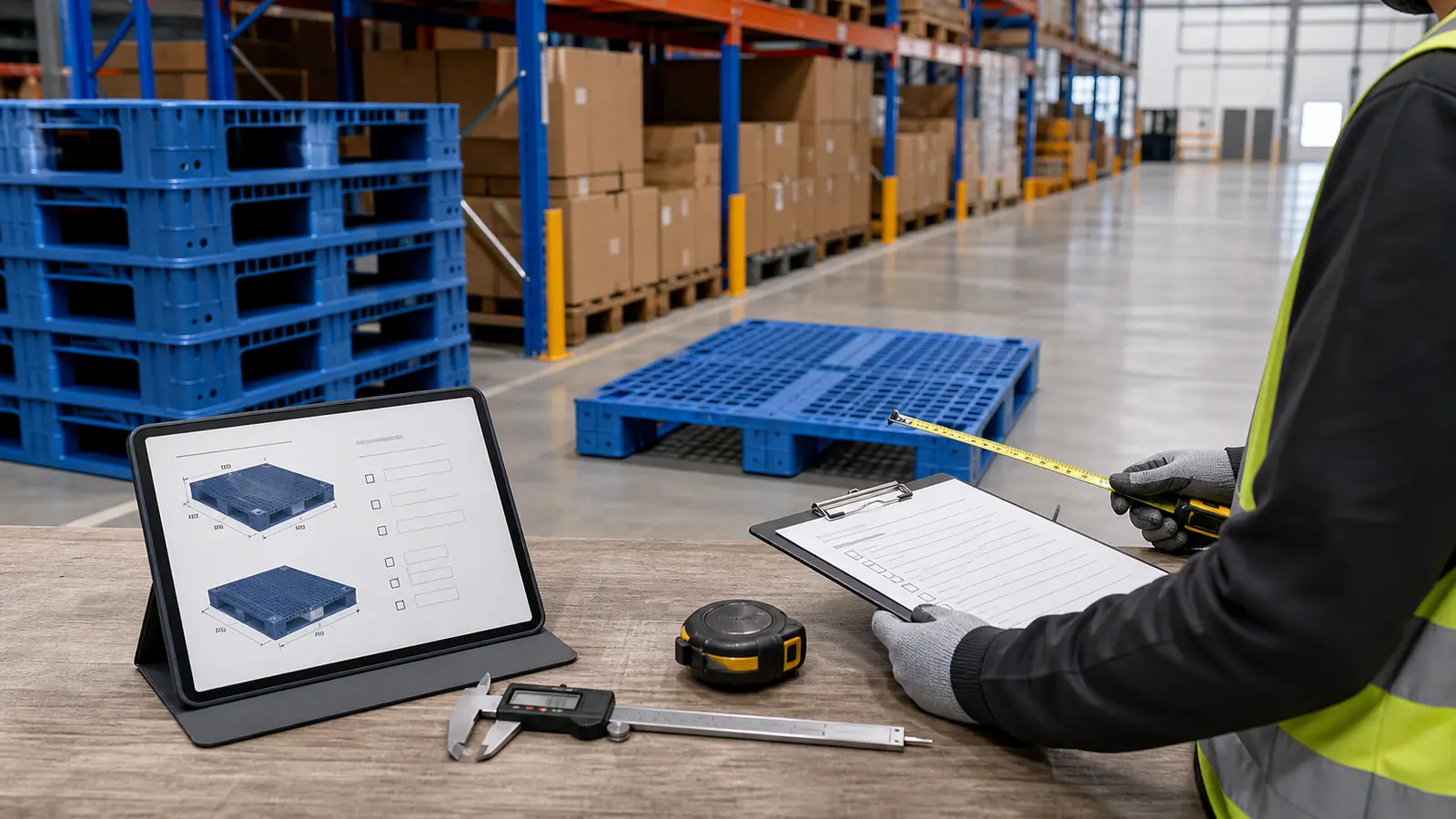
Record the required pallet footprint, height, fork-entry direction, and any tolerance limits. A common size such as 40 x 48 inches is not enough by itself. The pallet also has to fit the load, the rack bay, the handling equipment, conveyors if used, and any downstream storage or transport constraints.
Before requesting a quote, confirm whether the size is driven by existing rack layout, product packaging, truck loading, customer receiving rules, automation, or a legacy pallet standard. If the size is flexible, say so. A supplier can only suggest practical alternatives when the constraint is clear.
2. What will be loaded on the pallet?
Total load weight matters, but it is only one part of the application. Two unit loads can have the same weight and behave differently if one is made from evenly distributed cartons and another has drums, feet, skids, bins, or point contacts.
Provide the load footprint, maximum weight, typical weight, height, center of gravity, packaging type, and whether the load is evenly distributed. The UK Health and Safety Executive’s Pallet Safety guidance notes that load type and distribution affect whether a pallet is suitable for a use. That is why a quote request should include more than a target capacity number.
3. Will the pallet be used in rack storage?
If rack storage is part of the application, make that explicit in the first quote request. A pallet used on the floor is supported differently than a pallet spanning between rack beams. Do not rely on a floor-storage or general static rating for a racked application unless the manufacturer or qualified reviewer confirms the actual use case.
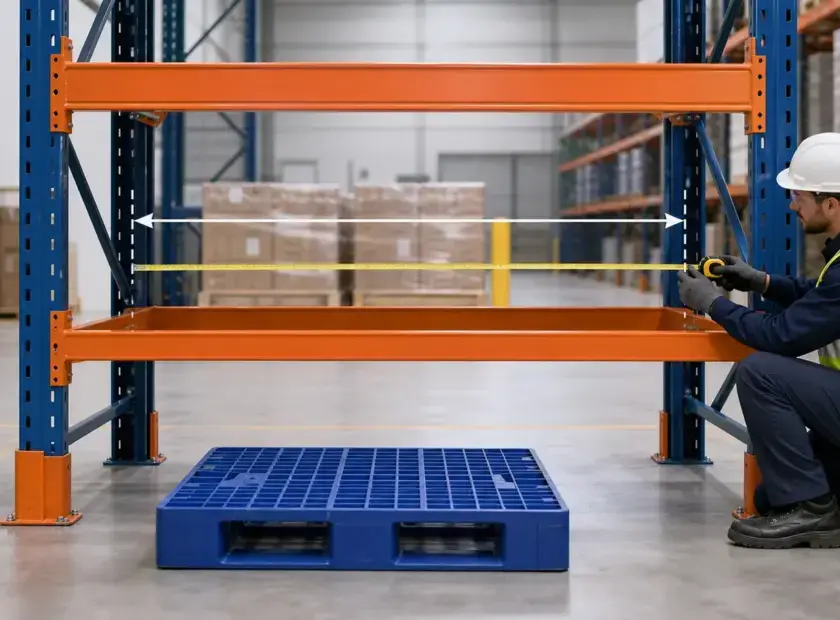
Include the rack type, beam spacing, beam depth, support surface, pallet orientation, and expected storage duration. For a refresher on site measurements, see the guide to measuring pallet rack beam spacing.
4. What support condition will the pallet see?
Rack support can mean open beams, edge support, support bars, wire decking, solid shelving, plates, or a combination of accessories. These conditions are not interchangeable. The same pallet may perform differently when supported only at two edges compared with broader support under more of the base.
Document the actual support condition and ask whether the quoted pallet is suitable for that condition. If the rack uses support bars or decking, include their spacing, rating, and position. The article on edge-rack vs full-perimeter support explains why this detail changes the question being asked.
5. What capacity label are you comparing?
Quote conversations often become confusing when static, dynamic, and racking capacity are treated as one number. They are different operating conditions. Static capacity usually relates to floor-supported storage, dynamic capacity relates to handling or movement, and racking capacity relates to the pallet spanning or bearing in rack storage under defined conditions.
Ask the supplier which capacity label applies to your application and what assumptions sit behind the quoted number. The guide to static, dynamic, and racking load capacity explains the difference in more detail.
6. What rating conditions does the quote assume?
A capacity value is only useful when the conditions are clear. Ask what beam span, support width, orientation, temperature, storage duration, load distribution, and deflection criteria were assumed. If the quote references testing, ask which test condition was used and whether it matches your rack setup.
The ISO 8611 series provides recognized pallet test-method, performance, and maximum-working-load context. The current ISO pages for ISO 8611-1, ISO 8611-2, and ISO 8611-3 are useful references for understanding why test conditions and working-load assumptions matter. A quote should still connect any referenced testing to the actual application.
7. What handling equipment will move the pallet?
Forklifts, pallet jacks, reach trucks, stackers, conveyors, and automated equipment can all create different requirements. Fork length, fork spacing, entry direction, turning radius, and placement accuracy may affect pallet selection.
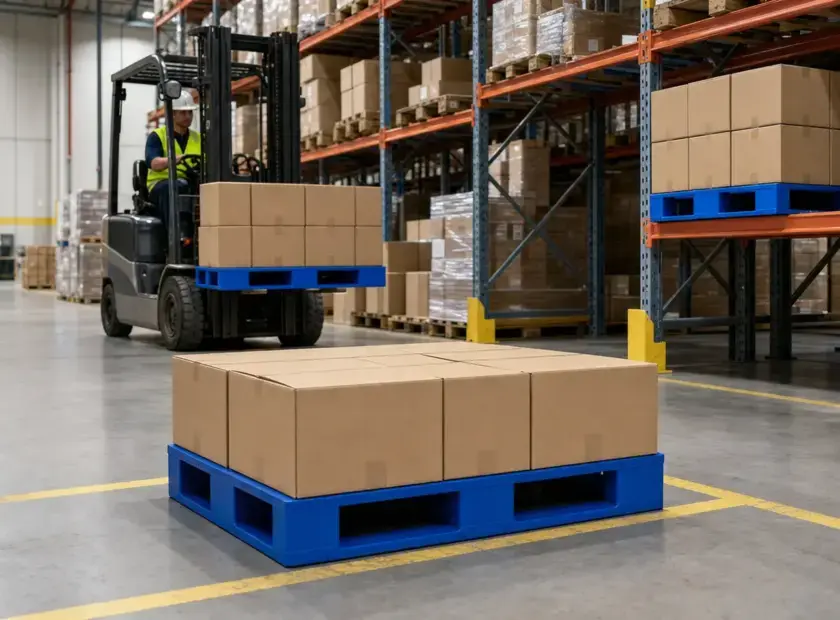
Tell the supplier how the pallet will be picked, transported, stacked, and placed into storage. If the pallet must work with multiple types of equipment, list each one. This is especially important where the pallet will move between floor staging, trailers, racks, production lines, and customer facilities.
8. How long will loaded pallets stay in storage?
Storage duration affects rack applications because a loaded pallet may deflect over time. Short handling cycles and long-term loaded rack storage are not the same use case. Temperature, load distribution, pallet design, and support condition can all influence how a pallet behaves under sustained load.
Include the maximum expected storage duration, not just the average. If some pallets remain loaded for days, weeks, or longer, make that clear in the request. Ask whether the quoted recommendation accounts for sustained loaded storage under your rack conditions.
9. What temperatures or environmental conditions apply?
Plastic pallet performance can be affected by application environment. Before requesting a quote, record whether the pallet will be used indoors, outdoors, in cold rooms, freezers, hot areas, wet areas, washdown areas, chemical exposure zones, or high-UV environments.
Do not assume a broad material description answers every environmental question. Ask the supplier what environmental limits or restrictions apply to the specific pallet model and whether any application details require written confirmation.
10. Are there sanitation, material, or compliance requirements?
Some buyers need pallets for food-adjacent handling, pharmaceutical support areas, export programs, closed-loop reuse, or other controlled environments. Those requirements can influence material, design, color, washability, documentation, and traceability needs.
List any compliance, sanitation, color, labeling, or documentation requirements in the quote request. Avoid assuming that a pallet is suitable for a regulated or controlled use unless the supplier can provide model-specific support for that claim.
11. Does the pallet need reinforcement?
Some rackable plastic pallet designs include reinforcement, while others are designed for lighter-duty or different support conditions. Reinforcement is not automatically required for every application, and it is not automatically sufficient for every rack application.
Ask whether the proposed pallet includes reinforcement, what role it plays, and whether the quoted capacity or suitability depends on that construction. Also ask whether the reinforcement changes inspection criteria, repair decisions, washdown practices, or end-of-life handling.
12. What inspection criteria will apply after purchase?
A quote should not end at the buying decision. Pallets used in racks need clear inspection and withdrawal rules so damaged or uncertain units do not keep circulating. HSE guidance supports inspecting pallets before use and withdrawing damaged pallets from service.
Ask for inspection guidance for the exact pallet model and intended application. Your team can also use a documented plastic pallet inspection checklist as a starting point for internal handling, isolation, and escalation procedures.
13. Who needs to approve the application?
A supplier quote can support the selection process, but it may not be the only approval needed. Depending on the site, final approval may involve the pallet supplier, rack provider, engineering support, safety leadership, insurance requirements, or customer receiving rules.
OSHA’s material-storage rule at 29 CFR 1910.176 requires stored materials to remain stable and secure against sliding or collapse. In practice, that stability depends on the complete unit-load system: pallet, product, rack, support accessories, equipment, operators, and site controls. Identify the internal owner who will review the full system before purchase.
14. What information should be included in the quote request?
For a more useful rackable pallet quote, collect the following before contacting suppliers:
- Pallet footprint, height, entry direction, and required tolerances
- Maximum and typical load weight
- Load footprint, contact pattern, height, and center of gravity
- Rack type, beam spacing, support surface, and pallet orientation
- Handling equipment, fork dimensions, cycle frequency, and placement method
- Storage duration, temperature range, and environmental exposure
- Sanitation, material, color, traceability, or compliance requirements
- Inspection, replacement, and documentation expectations
- Any customer, transportation, automation, or facility constraints
Photos, drawings, rack measurements, data sheets, and load diagrams can be especially helpful. They reduce ambiguity and make it easier to separate a general product match from an application-specific recommendation.
15. What should be kept out of the first quote comparison?
Price and availability matter, but they should not be the only first-screen filters for a rackable pallet. A low quote is not useful if the application details are missing or if the rating conditions do not match the site.
Before comparing price, confirm that each option is being evaluated against the same pallet size, rack support condition, load case, handling method, storage duration, and documentation need. Then compare commercial factors with the technical assumptions visible.
Use a complete application summary
A strong quote request reads like an application summary, not just a product inquiry. It tells the supplier what the pallet must support, where it will sit, how it will be handled, what environment it will face, and who needs documentation.
For more background, review the plastic pallet FAQ, the material handling glossary, and the broader rackable plastic pallets overview.
To discuss an application, contact the team with your pallet size, load details, rack support condition, handling equipment, storage duration, and environment. The more complete the request, the easier it is to identify the documentation and review steps needed before purchase.
Safety note: This article is a buyer-preparation guide. It is not a pallet certification, rack design, engineering approval, legal interpretation, or substitute for manufacturer instructions, rack documentation, applicable regulations, or a site-specific risk assessment.