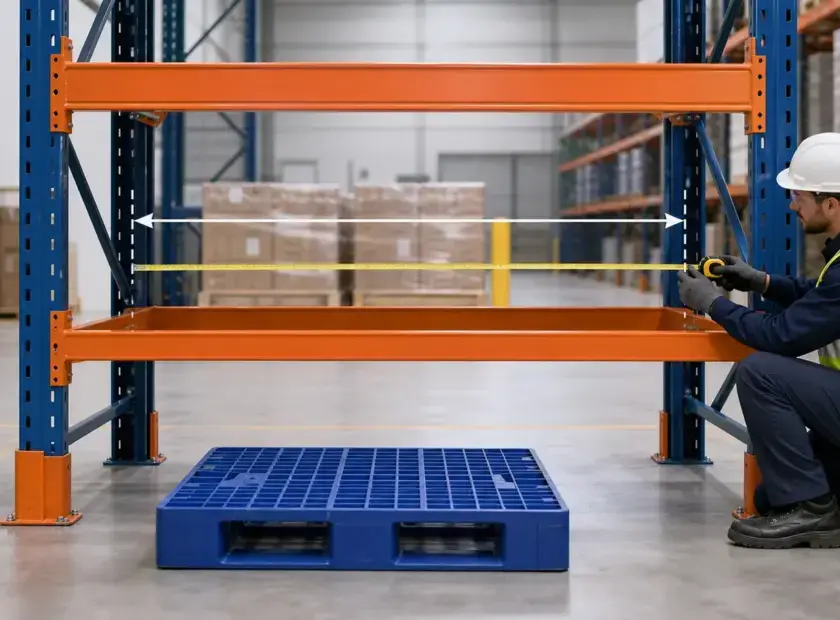
Choosing a pallet for elevated rack storage starts with a tape measure, not a capacity number. A supplier cannot confirm whether a plastic pallet is suitable for a rack unless the support condition is described accurately. “Standard rack,” “48-inch pallet,” or “two beams” leaves too much room for error.
The useful measurement is the actual unsupported span and support geometry the pallet will bridge. You also need to document pallet orientation, support bars or decking, unit-load weight and distribution, storage duration, handling equipment, and environmental conditions. Together, those details create an application profile that a pallet supplier, rack manufacturer, or qualified engineer can evaluate.
This guide explains how to collect that information without guessing at universal clearances or treating a pallet’s static capacity as a racking rating.
Why rack measurements matter
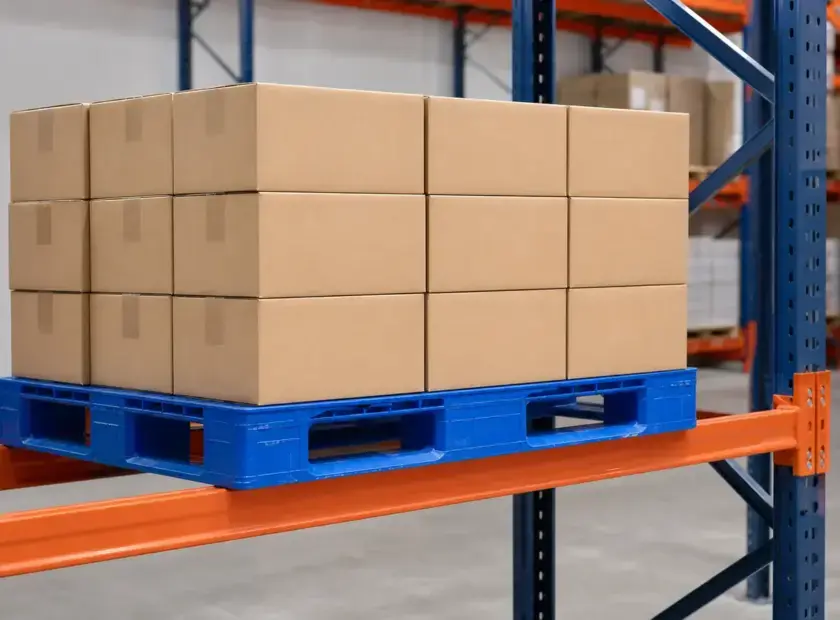
A pallet resting on a warehouse floor receives broad support. The same pallet placed in selective rack may bridge an open space between two beams. That unsupported span creates bending stress, and the result depends on more than the pallet’s outside dimensions.
Rack type, beam profile, pallet orientation, load distribution, support accessories, temperature, and time under load can all change the application. A pallet that works on closely spaced supports may not be suitable across a wider span. A rating for a uniformly distributed load may not apply to drums, machinery, or another concentrated load.
The UK Health and Safety Executive’s Pallet safety guidance advises users to communicate the rack type, whether support bars are fitted, the relevant span, the load and its distribution, the environment, and the handling method. It also states that loaded pallets should not be placed in racking unless they are designed and constructed for the rack type concerned.
First identify the rack system and support condition
Begin by naming the rack system. Selective pallet rack, drive-in rack, push-back rack, pallet-flow rack, and automated storage systems do not support or move pallets in the same way. Do not assume that measurements collected for one system describe another.
For each storage position, identify what physically contacts the pallet:
- Front and rear load beams
- Side rails in drive-in or drive-through rack
- Pallet support bars between the beams
- Wire decking, solid decking, or closely spaced rollers
- Cart or shuttle rails in a dynamic storage system
Photograph the empty storage position from the aisle and, where it can be done safely, from an angle that shows the support surfaces. Do not climb the rack or enter a restricted area to obtain a measurement. Follow the facility’s lockout, access, fall-protection, and traffic-control procedures.
How to measure a selective pallet rack position
For a conventional selective rack position, collect the following dimensions. Use a consistent unit, record where each measurement starts and ends, and avoid rounding until the application has been reviewed.
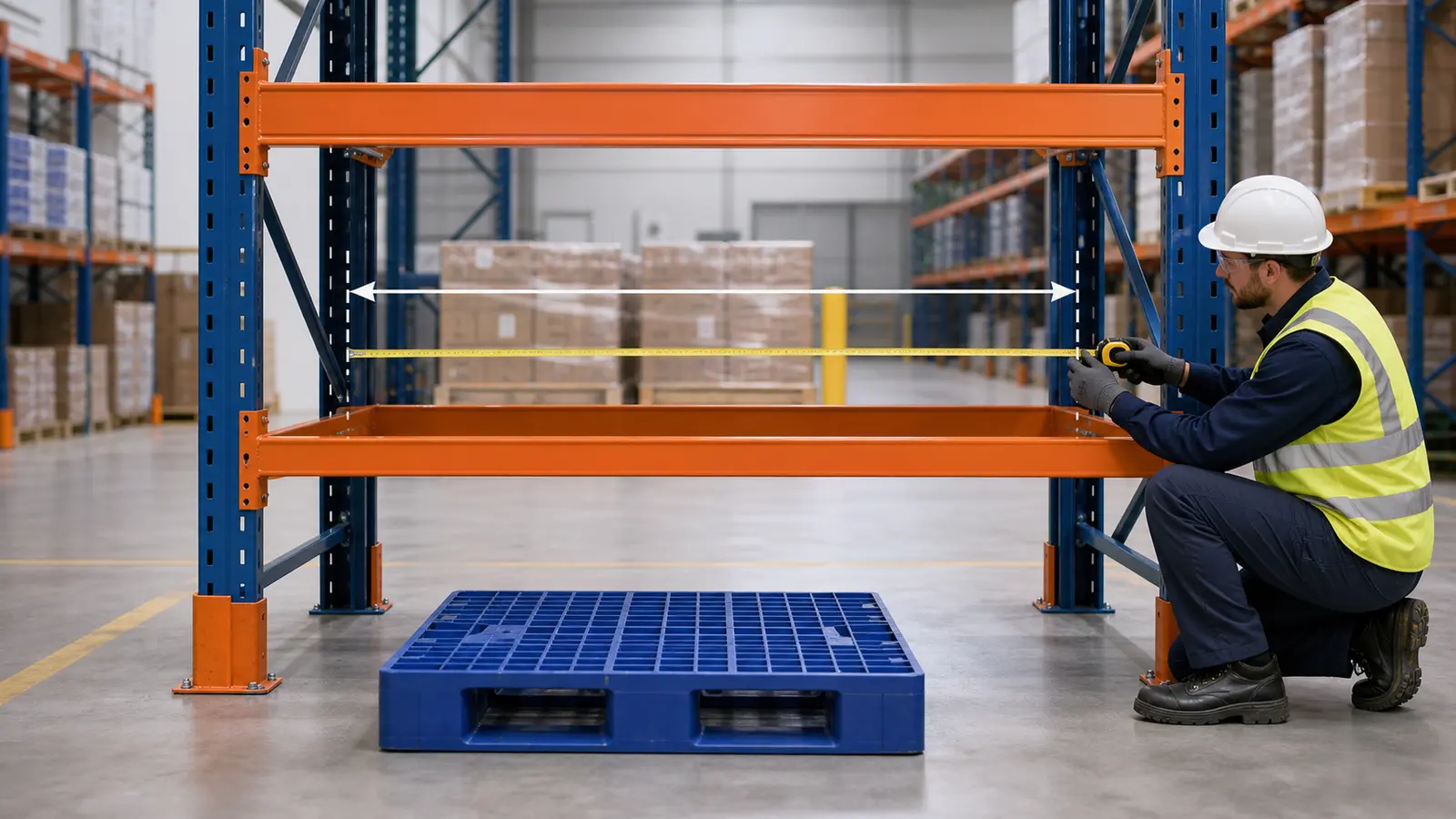
1. Clear distance between the supporting beam faces
Measure the horizontal distance between the inside edges of the surfaces that will support the pallet. This describes the open space the pallet must bridge. It is not necessarily the same as the distance between upright frames, the beam length, or the nominal bay width.
Record the beam profile as well. A step beam, box beam, structural channel, or another design can present a different bearing surface. Include the width of the top bearing surface that actually contacts the pallet.
2. Front and rear pallet bearing
Document how much of the pallet is expected to rest on each beam when it is correctly placed. The supplier needs to know the intended front and rear support, not just the pallet’s overall depth. Also note whether the rack or operating procedure permits variation in pallet placement.
Do not invent a minimum bearing dimension from a general article. Required bearing and placement tolerances depend on the rack design, pallet design, governing standard, and operating conditions. Confirm them with the responsible rack and pallet specialists.
3. Pallet orientation
State which pallet dimension runs from the front beam to the rear beam and which fork-entry direction the lift truck uses. A 40-by-48-inch pallet has two possible orientations, and they create different unsupported spans and handling approaches.
Mark the intended orientation on the worksheet and photographs. If operators can rotate the pallet, treat both orientations as possible until an operating control prevents the unsuitable one.
4. Support bars, decking, and their locations
Record the number, width, profile, and exact position of any pallet supports. A support bar or deck can change how the pallet carries its load, but its presence does not automatically make every pallet suitable.
Note whether wire decking is intended as a pallet support, a fall-through safeguard, or both. Confirm its rated use with the rack or deck manufacturer. Do not assume that mesh alone provides full, continuous support.
5. Bay and load clearances
Measure the available space around the planned unit load, including neighboring loads and rack components. OSHA’s materials-handling standard requires sufficient safe clearances where mechanical equipment operates, stable storage, and warning signs for clearance limits.
Clearance is an operating and rack-design issue, not simply a pallet dimension. Ask the rack provider or qualified engineer to confirm the required horizontal and vertical clearances for the system and handling equipment.
Measurements for drive-in, push-back, and pallet-flow rack
Dynamic and high-density systems need additional information because pallets may ride on rails, carts, or rollers and may experience forces while moving.
For drive-in or drive-through rack, document:
- Clear distance between the support rails
- Rail width and profile
- Required pallet bearing on each rail
- Entry direction and intended pallet orientation
- Guide rails, stops, and placement tolerances
- Whether multiple pallet sizes are used in the lane
For push-back or pallet-flow rack, also record the cart, wheel, or roller arrangement; lane pitch; pallet contact points; stops; expected travel; and any acceleration or impact conditions. The system provider should confirm pallet compatibility. A pallet that is rackable on stationary beams is not automatically compatible with moving carts or rollers.
Document the unit load, not just the pallet
Rack dimensions describe only half of the application. The supplier also needs an accurate unit-load profile:
- Maximum product and packaging weight
- Pallet tare weight, if known
- Total loaded pallet weight
- Load footprint and height
- Whether weight is uniform or concentrated
- Number, size, and location of drums, feet, bins, or other contact points
- Center of gravity and potential for load shift
- Stretch wrap, straps, corner boards, or other restraints
Use the maximum credible operating load, not an average. If the product mix changes, create separate profiles for materially different loads. HSE guidance notes that a pallet designed for an evenly distributed load may not be strong enough for a concentrated load of the same total weight.
Add time, temperature, and handling details
Plastic can continue to deform under a sustained load, a behavior called creep. Record the longest expected time a loaded pallet will remain in the rack, along with the normal and extreme temperatures. Cold storage, heat, outdoor exposure, wash processes, chemicals, and moisture should be disclosed.
Identify every handling interface: forklift, reach truck, pallet jack, conveyor, automated storage and retrieval equipment, clamps, or other machinery. Include fork direction, conveyor spacing, and any known impact or braking conditions. These facts help prevent a pallet from being approved for storage but failing to work with the rest of the material-handling system.
A rack measurement worksheet
Use this checklist for each distinct rack configuration:
- Rack identification: building, aisle, bay, level, rack type, and equipment owner.
- Support geometry: clear span, bearing surface width, front and rear bearing, rail spacing, and pallet orientation.
- Accessories: support bars, wire deck, solid deck, carts, rollers, stops, and their positions.
- Unit load: maximum total weight, footprint, height, distribution, contact points, and restraint method.
- Environment: temperature range, storage duration, moisture, chemical, wash, and outdoor exposure.
- Handling: truck type, fork direction, conveyor or automation interfaces, and placement tolerances.
- Evidence: dated photographs, dimensioned sketch, rack drawings, pallet data sheet, and responsible contacts.
Measure more than one nominally identical bay. Damage, repairs, mixed rack components, or installation variation may create different conditions. Escalate discrepancies rather than selecting the most convenient number.
What to send with a pallet inquiry
A useful inquiry includes the completed worksheet, photographs, a dimensioned sketch, and the exact rack and load details. Ask the supplier to identify the proposed pallet model and confirm the support condition used for its racking recommendation.
Questions should include:
- Does the rating apply to this exact span, orientation, and support profile?
- Is the stated value a recommended working load or another type of rating?
- What load distribution, duration, and temperature does it assume?
- What deflection or long-term deformation should be expected?
- Are reinforcement, support bars, or decking required?
- What damage or permanent deformation removes the pallet from service?
- Does the handling or automation system require separate validation?
For a fuller explanation of capacity terms and support conditions, read what makes a plastic pallet rackable. The site’s plastic pallet FAQ and material handling glossary provide additional terminology.
Before placing a pallet in service
A measurement sheet supports a technical decision; it does not replace one. Confirm the combined pallet, rack, load, and handling application with the relevant manufacturers or a qualified professional. Document the approved pallet model and orientation, train operators, and establish inspection and removal criteria.
Never use a damaged, unidentified, or substituted pallet merely because its outside dimensions match. OSHA requires stored materials to remain stable and secure against sliding or collapse. Application-specific approval and consistent operating controls are essential parts of meeting that responsibility.
To discuss a rackable plastic pallet application, review the rackable pallet overview and contact the team. Include your measurement worksheet, rack photographs, maximum unit-load details, storage duration, and operating temperature so the application can be reviewed efficiently.
Safety note: This article provides a documentation workflow, not an engineering approval or a universal clearance specification. Follow site safety procedures and obtain application-specific confirmation before using pallets in elevated storage.