A rackable pallet decision should leave a paper trail. The pallet may look simple, but the selection depends on the load, rack support, handling equipment, storage duration, environment, and approval path. If those details live only in email threads or verbal notes, a buyer can end up comparing products that were never evaluated against the same use case.
This rackable pallet documentation checklist is written for procurement, warehouse, operations, and safety teams that need a clearer way to collect and review pallet information before purchase or reuse. It is not a substitute for manufacturer instructions, rack documentation, engineering review, or site-specific approval. It is a practical framework for organizing the questions that those reviewers usually need answered.
If you are still defining what rackability means, start with what makes a plastic pallet rackable. If you already know the application and are preparing supplier conversations, this checklist can sit alongside your rackable pallet quote questions.
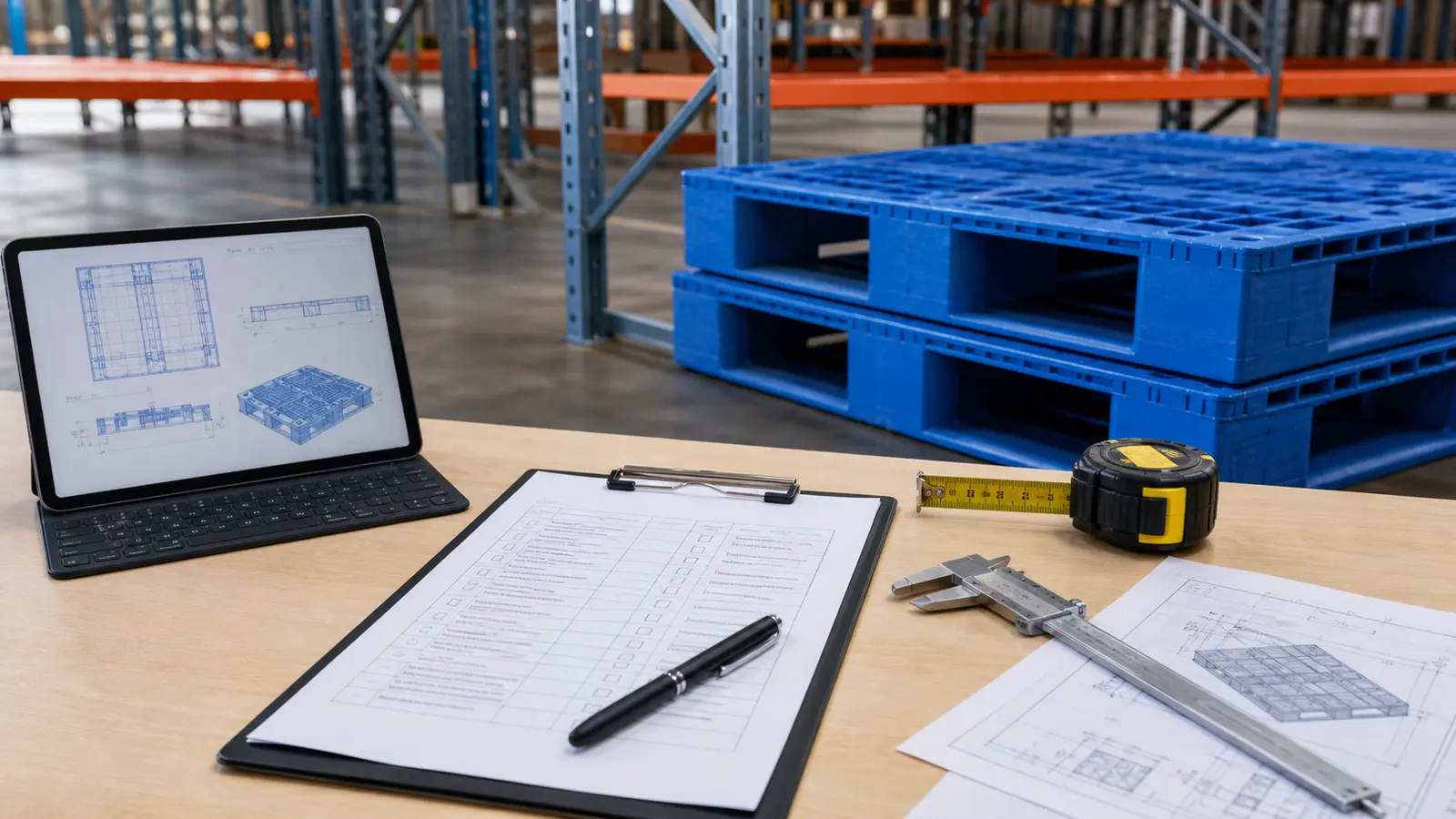
Why documentation matters for rackable pallets
Rackable pallet decisions often fail when teams compare labels instead of conditions. A capacity number, product family name, or material description does not explain how the pallet was supported, what load was used, how long it was stored, what temperature applied, or whether the use matched the supplier’s assumptions.
Documentation helps prevent that drift. It gives procurement a consistent request, gives operations a record of what was approved, gives safety teams a basis for inspection and withdrawal rules, and gives future buyers a way to understand why a pallet was selected. It also reduces the risk of reusing one product recommendation for a different rack, load, or facility without review.
The UK Health and Safety Executive’s Pallet Safety guidance is aimed at those responsible for pallet design, purchase, use, storage, handling, and transport. OSHA’s 29 CFR 1910.176 requires stored materials to remain stable and secure against sliding or collapse. A documentation checklist helps connect those broad safety principles to the specific pallet, load, rack, and handling conditions in front of your team.
1. Record the exact pallet identity
Start with the basics that identify the pallet without ambiguity. Record the supplier, manufacturer if known, model name or number, revision, material, footprint, height, deck style, base style, fork-entry configuration, color, reinforcement details, and any available data sheet reference.
A generic description such as “blue rackable pallet” is not enough for a controlled file. If the product is replaced, redesigned, sourced from another manufacturer, or quoted under a different part number, the old approval may not apply. Keep product photos, drawings, and the exact quote or data sheet with the file so later reviewers know which pallet was evaluated.
2. Document pallet dimensions and tolerances
Record the pallet footprint, height, fork openings, bottom-deck contact points, runner or perimeter-base layout, and any dimensional tolerances that matter to the site. Include the unit of measure and the source of the measurement. If the dimensions came from a supplier data sheet, keep that data sheet. If they were measured on site, record who measured them and when.
Dimensions should be checked against rack beam spacing, pallet orientation, handling equipment, conveyors, trailers, automation, and customer receiving requirements. The guide to measuring pallet rack beam spacing explains how to capture the rack side of that compatibility check.
3. Define the load case
The file should describe what sits on the pallet, not just the maximum weight. Record the product type, packaging type, load footprint, contact pattern, typical and maximum load weight, load height, center of gravity, whether the weight is evenly distributed, and whether the load changes during storage or handling.
Loads with feet, drums, totes, bins, point contacts, liquid movement, or off-center weight can behave differently than evenly distributed cartons. If more than one load type will use the same pallet, document each load case and avoid assuming that the heaviest load is automatically the only relevant one.
4. Capture the rack support condition
Rack support is one of the most important parts of the file. Record whether the pallet will sit on open beams, edge support, support bars, wire decking, solid decking, plates, drive-in rails, flow rack, push-back rack, or another support arrangement. Include beam spacing, beam depth, support-bar spacing, deck type, pallet orientation, and any rack accessory details that change the support surface.
The difference between edge support and broader support can change the question being asked of the pallet. For more background, see the guide to edge rack vs full-perimeter support.
5. Keep capacity evidence tied to conditions
Do not store a capacity value without its conditions. A good file records whether the number is static, dynamic, racking, stack, or another rating; the support condition; test method or source; load distribution; temperature; storage duration; pallet orientation; and any deflection or inspection criteria that apply.
The ISO 8611 series provides standards context for pallet test methods, performance requirements, and maximum working loads. ISO’s current pages identify ISO 8611-1:2025 for test methods, ISO 8611-2:2025 for performance requirements and selection of tests, and ISO 8611-3:2011 for maximum working loads. If a supplier references a standard, keep the documentation that explains how the cited testing relates to the actual application.
For a plain-language comparison of rating labels, review static, dynamic, and racking load capacity.
6. Record handling equipment and movement paths
A pallet may be compatible with one handling method and problematic with another. Record forklifts, reach trucks, pallet jacks, stackers, conveyors, automated systems, and any transfer points between areas. Include fork length, fork spacing, entry direction, lift height, placement accuracy, and whether the pallet will be handled loaded, empty, or both.
Also document the movement path. A pallet that moves from production to staging to rack storage to trailer loading may face more than one condition. If the site has tight aisles, dock plates, ramps, freezer doors, washdown zones, or customer return loops, include those details in the review file.
7. Define storage duration and environment
Storage duration matters because a loaded pallet in a rack may deflect over time. Record the expected average and maximum loaded storage duration, especially if some pallets remain loaded for days, weeks, or longer. Avoid relying only on a short handling-cycle assumption if the site will use sustained loaded storage.
Environmental details belong in the same file. Record indoor or outdoor use, temperature range, freezer or cold-room use, heat exposure, washdown, moisture, chemicals, UV exposure, dust, sanitation requirements, and any controlled-environment restrictions. Ask the supplier or qualified reviewer whether the proposed pallet model has limitations under those conditions.
8. List compliance, sanitation, and customer requirements
Some applications need documentation beyond mechanical fit. Record any sanitation, food-adjacent handling, pharmaceutical support, export, traceability, color, labeling, closed-loop reuse, recycled-content, or customer receiving requirements. Keep the source of each requirement so future reviewers know whether it came from an internal policy, customer requirement, regulation, supplier claim, or operational preference.
Avoid treating broad marketing language as approval evidence. If a regulated or controlled use matters, keep model-specific support from the supplier or another appropriate reviewer.
9. Attach inspection and withdrawal criteria
The documentation file should explain how the pallet will be inspected after purchase. Include known damage criteria, isolation rules, escalation contacts, cleaning limits, repair restrictions if any, and the point at which a pallet should be removed from service. Keep the criteria specific enough for supervisors and operators to apply consistently.
For an operational starting point, use the plastic pallet inspection checklist. Then adapt it to the exact pallet model, rack application, and supplier guidance.
10. Identify approval owners
Rackable pallet documentation should make ownership visible. Record who reviewed the pallet selection, rack compatibility, load case, safety requirements, procurement terms, and any customer or insurance requirement. Depending on the site, that may involve procurement, warehouse leadership, safety, engineering, maintenance, the rack provider, the pallet supplier, or a qualified external reviewer.
Also record what each reviewer approved. A supplier product quote is not the same as a rack-system approval, a site safety review, or a customer receiving approval. Separate those decisions so the file does not imply broader sign-off than was actually given.
11. Keep a change-control log
A pallet file should not be frozen after the first purchase. Add a simple change log that records revisions to the pallet model, supplier, load, rack layout, support accessories, handling equipment, storage duration, environment, inspection rules, and approval owner. Any material change should trigger a review before the old decision is reused.
Change control is especially important when a site adds support bars, changes beam spacing, introduces a heavier product, moves into cold storage, shifts to automated handling, or switches from one pallet supplier to another.
12. Use a one-page application summary
The most useful output from this checklist is a one-page application summary. It should include:
- Pallet supplier, model, part number, drawing, and data sheet reference
- Pallet footprint, height, entry direction, base style, and reinforcement details
- Load type, maximum weight, contact pattern, height, and distribution
- Rack type, beam spacing, support condition, pallet orientation, and accessories
- Handling equipment, movement path, cycle frequency, and placement method
- Storage duration, temperature range, moisture, UV, chemicals, and washdown exposure
- Capacity source, rating type, assumptions, and any test-condition notes
- Inspection criteria, withdrawal rules, cleaning limits, and escalation contact
- Compliance, sanitation, customer, traceability, or documentation requirements
- Approval owners, approval date, review date, and change-control notes
Keep the summary with supporting documents rather than replacing them. Photos, rack measurements, pallet drawings, supplier data sheets, quote records, load diagrams, and inspection instructions all help future teams understand the decision.
Red flags in a rackable pallet file
Review the file again if any of these issues appear:
- The pallet model is described only by color or generic product type.
- A capacity value appears without support condition, temperature, duration, or load-distribution assumptions.
- The rack support condition is missing or described differently across documents.
- The file mixes static, dynamic, and racking ratings without explaining which one applies.
- The supplier quote, rack review, and internal approval are treated as the same decision.
- The load case changed after approval, but the file was not reviewed.
- Inspection and withdrawal criteria are missing for pallets used in rack storage.
Make the documentation easy to maintain
The checklist only works if it is practical. Store the file where procurement, operations, and safety teams can find it. Use a consistent naming convention, assign a document owner, and set a review date. For active pallet programs, review the file after product changes, rack changes, recurring damage, supplier changes, safety incidents, or repeated operator concerns.
For definitions, use the material handling glossary. For general questions, review the plastic pallet FAQ. For broader commercial context, visit the rackable plastic pallets overview.
To discuss an application, contact the team with your pallet model, load details, rack support condition, handling equipment, storage duration, environment, and any documentation requirements. A complete file makes the review more useful and reduces the chance that an important condition is missed.
Safety note: This article is a documentation guide. It is not a pallet certification, rack design, engineering approval, legal interpretation, or substitute for manufacturer instructions, rack documentation, applicable regulations, or a site-specific risk assessment.