A plastic pallet can behave very differently depending on how it is supported in storage. The same pallet may rest on a flat floor, sit on rack beams, span across support bars, or sit on wire decking. Those support conditions change how the pallet and load share stress.
That is why a phrase such as rackable pallet should never be treated as a complete approval by itself. Rackability depends on the pallet model, the load, the rack type, the orientation, the span, the support surface, the environment, and the time the load will remain in storage.
This guide explains the practical difference between edge-rack support and broader full-perimeter or decked support. It is intended to help warehouse, procurement, and safety teams ask better questions before choosing or approving a plastic pallet for rack storage.
What does edge-rack support mean?
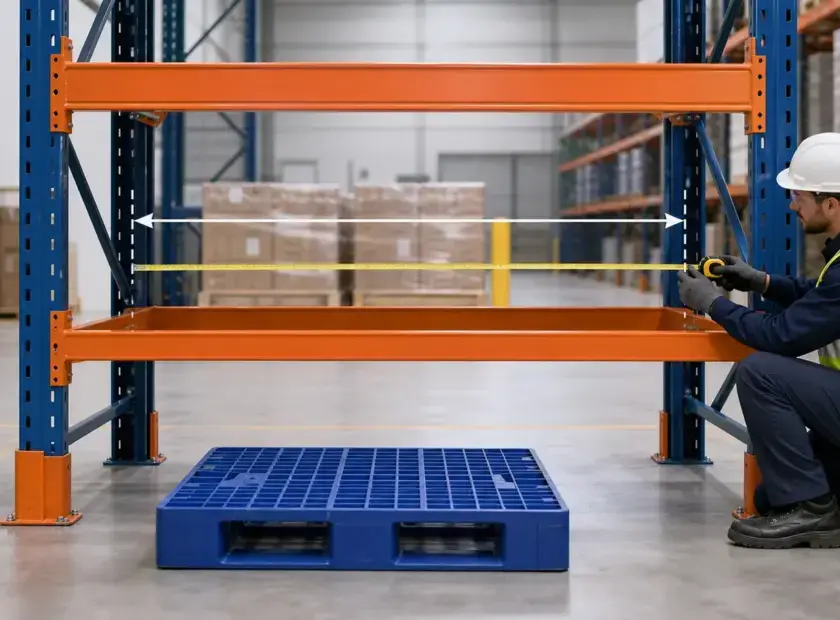
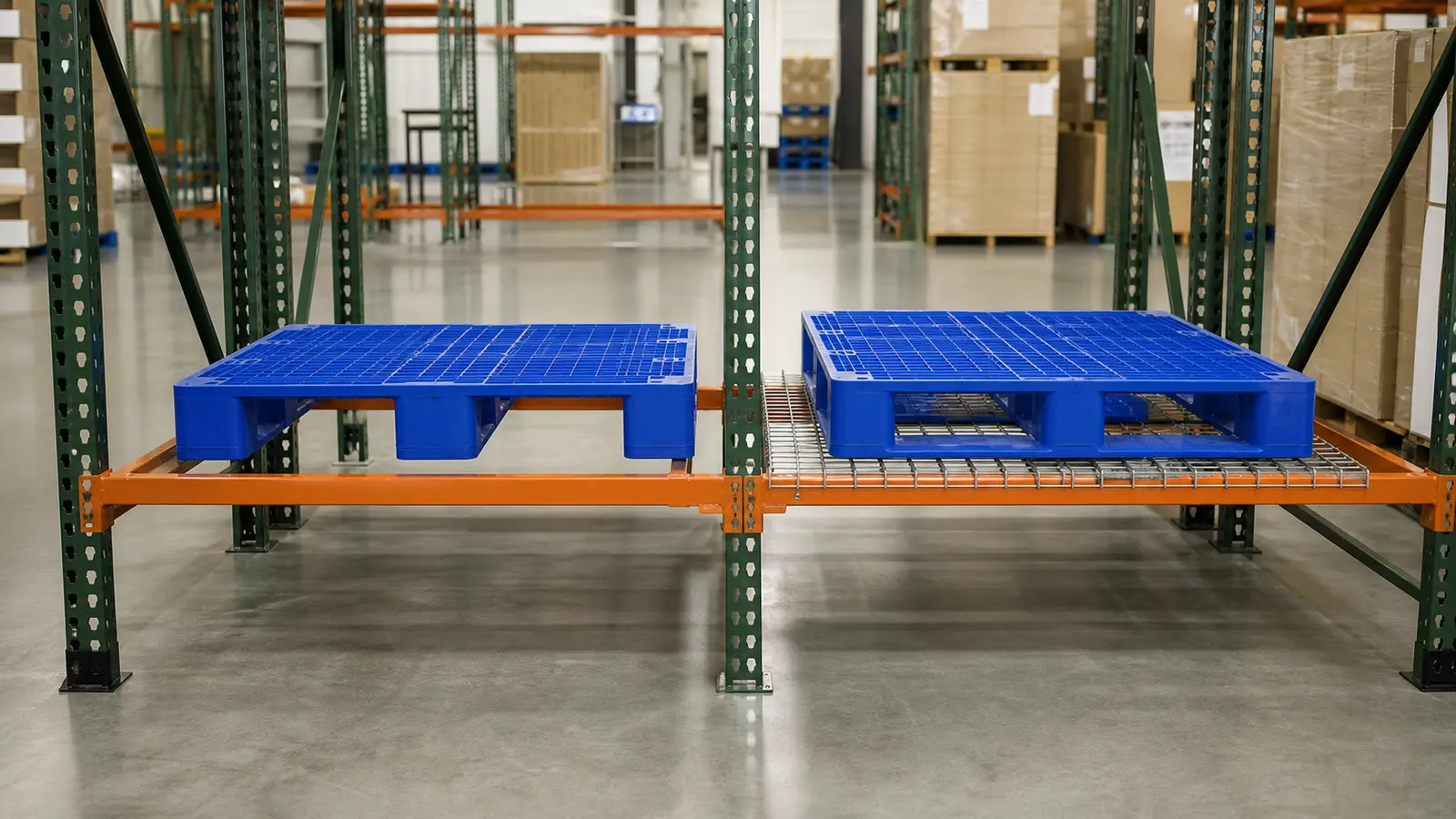
Edge-rack support usually describes a condition where the pallet is supported mainly at two opposite edges, commonly by the front and rear beams of a selective pallet rack. The pallet and unit load must bridge the open span between those supports.
This condition can be demanding because much of the pallet base is unsupported. The deck, runners, stringers, blocks, and any reinforcement must transfer the load across the open distance while controlling deflection and keeping the unit load stable.
Useful rack documentation should identify at least:
- The clear distance between the supporting rack beams
- The bearing width available at each supported edge
- The direction the pallet enters and sits in the bay
- The amount of overhang or underhang at each beam
- Whether support bars, decking, plates, shelves, or other accessories are present
- The load weight, contact pattern, and center of gravity
- The expected storage duration and temperature range
The UK Health and Safety Executive’s Pallet Safety guidance warns that loaded pallets should not be stored in racking unless they are designed and constructed for the rack type concerned. That principle is central to edge-rack decisions: the rack type and support geometry are part of the approval, not background details.
What does full-perimeter support mean?
Full-perimeter support is a broader support condition where the pallet base is carried around more of its outside footprint rather than only at two opposite edges. In practice, this may involve a shelf, properly designed decking, closely spaced support members, or another structure that reduces unsupported span.
Broader support can reduce bending across a long open span, but it is not a universal substitute for a rackability rating. The support still needs to match the pallet design and load. Thin ledges, uneven decking, damaged wire, missing supports, or point contacts can create new problems even when the pallet appears to be supported over a larger area.
Before treating a support condition as full-perimeter or broadly supported, confirm:
- Which parts of the pallet base actually touch the support
- Whether the support is continuous, level, and strong enough for the unit load
- Whether gaps in decking leave pallet feet, runners, or deck sections unsupported
- Whether the support system is approved by the rack owner, rack manufacturer, or a qualified professional
- Whether the pallet manufacturer recognizes that support condition for the specific model
Why support condition changes pallet performance
A loaded pallet is a structural part of a unit-load system. When the support points move, the forces inside that system move too.
On a floor, the pallet may receive broad support under much of its base. In edge-rack storage, the pallet may need to bridge a span between two beams. On wire decking, contact may occur through a grid rather than a continuous shelf. On support bars, contact may occur only where the bars meet the pallet base.
Those changes affect:
- Deck and runner bending
- Local pressure where the pallet contacts the support
- Deflection over time
- Load stability and leaning risk
- Fork-entry clearance after storage
- Damage tolerance during repeated use
Plastic pallets can also show time-dependent deflection under sustained load, especially when load, span, temperature, and storage duration are unfavorable. A pallet that looks acceptable during a short lift may not automatically be suitable for long-term rack storage under a different support condition.
Edge-rack support is not the same as floor storage
A common selection mistake is to rely on a floor-supported or static-load value when the real application is edge-rack storage. A static rating usually assumes broad support on a floor or another firm surface. Edge-rack storage creates a span.
Our guide to static, dynamic, and racking load capacity explains why those rating labels should be read separately. For this specific topic, the key point is simple: edge-rack approval should come from a racking rating or written model-specific confirmation for the actual support geometry.
If a data sheet lists a racking capacity, ask what support condition it describes. The published number may be tied to a particular beam spacing, orientation, load distribution, temperature, duration, and deflection criterion. If your rack bay or load case differs, the number may not apply without further confirmation.
Support bars, wire decking, and shelves are not interchangeable
Rack accessories can change the support condition, but they do not all work the same way.
Support bars may reduce unsupported span when they are correctly positioned and rated. Their spacing matters. A support bar that does not contact the pallet base, misses the pallet’s structural members, or is displaced from its intended location may not provide the expected support.
Wire decking can provide broader support than open beams, but the load path still depends on wire gauge, deck rating, waterfall or channel design, pallet base geometry, and how the pallet sits on the grid. Small pallet feet or narrow runners may not bear evenly on every deck style.
Solid shelves or plates may create broader contact, but they also need appropriate rating, secure installation, fire-safety compatibility, inspection, and approval for the rack system and stored load.
Do not assume an accessory converts every pallet into a rackable pallet. Instead, document the exact rack-support arrangement and confirm it against both pallet and rack requirements.
Load distribution matters as much as support
Two loads with the same total weight can behave very differently. Evenly distributed cartons spread force across the deck. Drums, pails, bins, machinery, or containers with feet can place concentrated loads on small areas.
HSE gives the example that a pallet suitable for evenly distributed cartons or sheet paper may not be strong enough for a concentrated item of the same weight. That example applies directly to support-condition review. A concentrated load can stress the pallet locally while edge-rack support stresses it globally across the span.
When requesting approval, include photos or drawings showing:
- The load footprint on the pallet deck
- Any feet, skids, runners, drums, pails, or point contacts
- Overhang or uneven loading
- Load height and center of gravity
- Restraint method, such as stretch wrap, bands, or boxes
- Whether the load can shift during handling or storage
OSHA’s material-storage rule requires stored materials to remain stable and secure against sliding or collapse. Stability depends on the complete system: pallet, load, rack, support accessories, handling, and operating controls.
Orientation can change the answer
Turning a pallet 90 degrees in the rack can change which pallet members bridge the span and where the load bears on the support. A pallet approved in one orientation should not automatically be treated as approved in another.
Record whether the pallet will sit with its long side or short side facing the aisle. Also record the fork-entry direction, because handling orientation and storage orientation are often linked in real operations. If the pallet must be placed from more than one direction, confirm each condition.
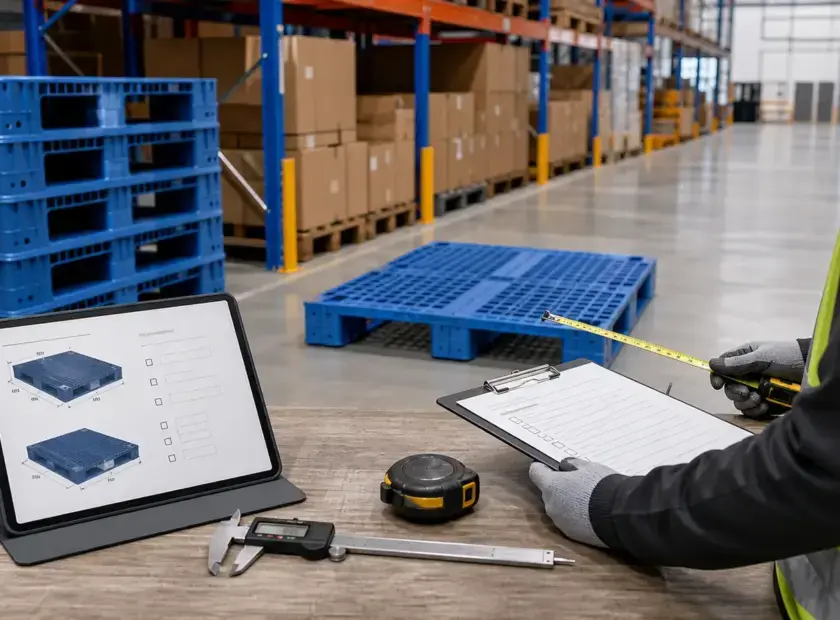
The guide to measuring pallet rack beam spacing outlines the site measurements that are useful before a supplier, rack provider, or qualified professional reviews the application.
Inspection standards should match the support condition
A pallet used on a broad floor support may tolerate some wear differently than a pallet spanning rack beams. Cracks, permanent deformation, damaged runners, exposed reinforcement, crushed corners, or distorted bases can be more serious when the pallet must bridge an open span.
Use a documented plastic pallet inspection checklist and remove uncertain units from service until they are reviewed. HSE guidance supports inspecting pallets before use and withdrawing damaged pallets from service. For rack storage, the rejection criteria should reflect the actual rack-support condition, not just the pallet’s appearance on the floor.
Questions to ask before using edge-rack storage
- Is this exact pallet model rated or approved for edge-rack storage?
- What rack span, bearing width, orientation, and load distribution were assumed?
- Does the rating require support bars, wire decking, or another accessory?
- Where must those accessories be positioned, and how are they inspected?
- What temperature and storage duration were used for the stated rating?
- What deflection or deformation limit applies?
- Does the load create point contacts or an uneven center of gravity?
- How does damage or age affect continued use in racks?
- Who is responsible for final approval: pallet supplier, rack provider, engineer, or site safety owner?
Questions to ask before relying on full-perimeter support
- Is the support truly continuous around the pallet base, or are there gaps?
- Does the pallet base line up with the supported areas?
- Are the decking, shelf, bars, or plates rated for the load?
- Is the accessory compatible with the rack system and fire-safety requirements?
- Does the pallet supplier recognize this support condition?
- Could the pallet shift off the supported area during placement or retrieval?
- How will the support system be inspected for damage or displacement?
A practical support-condition checklist
Before choosing or approving a pallet for rack storage, collect:
- Pallet details: model, dimensions, material, base style, reinforcement, age, and condition
- Load details: maximum weight, footprint, contact pattern, height, center of gravity, and restraint
- Rack details: rack type, beam spacing, beam depth, bearing width, orientation, and clearances
- Support details: open beams, edge support, support bars, decking, shelves, plates, or other accessories
- Handling details: forklift type, fork spacing, entry direction, placement accuracy, and cycle frequency
- Environment: storage duration, temperature range, moisture, chemical exposure, and outdoor exposure
- Documentation: pallet data sheet, rack documentation, inspection criteria, and written application approval
The ISO 8611 series provides a recognized framework for pallet test methods, performance requirements, and maximum working loads. If a supplier references ISO testing, ask which test condition and support arrangement were used and whether that condition matches your rack bay.
Request an application-specific review
Edge-rack and full-perimeter support decisions should be made from the actual pallet, load, and rack details, not from a generic product label. For help narrowing the right questions, review what makes a plastic pallet rackable, the plastic pallet FAQ, and the material handling glossary.
To discuss a rackable plastic pallet application, contact the team with your pallet dimensions, load details, rack span, support accessories, handling method, storage duration, and temperature range. The more complete the support-condition information is, the easier it is to identify what documentation or review is still needed.
Safety note: This article explains support-condition terminology and documentation questions. It is not a rack design, pallet certification, engineering approval, or substitute for manufacturer instructions, rack documentation, applicable regulations, or a site-specific risk assessment.