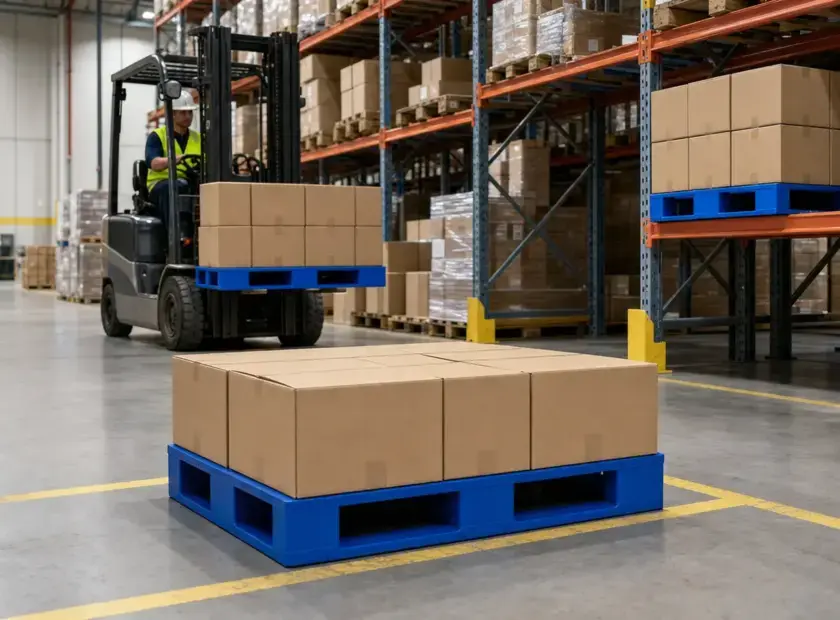
A plastic pallet data sheet may list static, dynamic, and racking load capacities as three separate values. Those numbers describe different support and handling conditions. Treating the largest number as a universal pallet capacity can create a serious selection error.
A pallet that supports a load while resting fully on a flat floor does not experience the same stresses as one carried on forklift tines or spanning rack beams. The load itself also matters: evenly distributed cartons behave differently from drums, bins, coils, machinery, or other concentrated loads of the same total weight.
This guide explains how to read the three ratings, what each one does not prove, and what application details to confirm before selecting a pallet. The exact manufacturer’s data sheet, test conditions, and written approval for the proposed use always take precedence.

Static, dynamic, and racking load capacity at a glance
Suppliers commonly use these labels to separate three broad conditions:
- Static load capacity generally describes a loaded pallet resting on a flat, firm surface with broad support beneath the base.
- Dynamic load capacity generally describes a loaded pallet being lifted and moved by compatible material-handling equipment.
- Racking load capacity generally describes a loaded pallet stored on specified rack supports with an unsupported span between them.
These are useful starting definitions, not complete approvals. Terminology, test setup, allowable deflection, duration, temperature, load distribution, support geometry, and safety factors can differ among manufacturers. Ask for the definition and conditions attached to the exact published value rather than comparing numbers alone.
What is static load capacity?
A static rating usually applies when a loaded pallet is stationary and supported by a level floor or another firm surface over much of its base. This broad support limits the distance that deck and base members must span.
Static capacity is often the highest number on a data sheet because the support condition is less demanding than lifting or beam racking. That does not make it the pallet’s all-purpose working capacity. A high floor-load rating does not by itself establish suitability for forklift movement, conveyor use, stacking, or rack storage.
Before relying on a static value, confirm:
- Whether the load must be uniformly distributed
- Whether the floor must be flat, level, rigid, and continuous
- Whether the value applies to a single pallet or a stack of loaded pallets
- How long the load may remain in place
- What temperature and environmental conditions were assumed
- Whether the load rests on the deck through cartons, bags, drums, feet, or point contacts
Block stacking introduces another system of forces. The bottom pallet may receive load through the pallet or package above it, while boxes, bags, and plastic components can deform over time. The UK Health and Safety Executive’s Pallet Safety guidance advises considering the bottom pallet, the baseboards’ ability to spread load, payload distortion, humidity, temperature, and information from the pallet manufacturer when setting stacking conditions.
What is dynamic load capacity?
A dynamic rating usually applies while a pallet is lifted and transported by a forklift, pallet truck, or another handling device under specified conditions. The pallet is no longer broadly supported by the floor. Its structure must transfer the unit load through the fork or wheel contact areas while the equipment accelerates, brakes, turns, crosses joints, and encounters normal operating vibration.
The word dynamic does not mean that any equipment, speed, fork position, load shape, or route is acceptable. The supplier may have based the rating on a particular fork spacing, entry direction, support length, load distribution, temperature, or test method.
Document at least these variables:
- Forklift, pallet-jack, automated vehicle, or other equipment type
- Fork length, width, thickness, spacing, and entry direction
- Two-way or four-way entry requirement
- Load weight, center of gravity, footprint, height, and restraint method
- Travel surface, gradients, dock plates, joints, thresholds, and turning areas
- Expected impacts, acceleration, braking, and handling frequency
- Operating temperature and chemical exposure
HSE guidance says the pallet designer needs to know how the pallet will be moved, whether conveyors or automated equipment are involved, and how the load is distributed. It also recommends square fork entry, suitable fork spacing, and adequate fork support. Those details explain why two operations moving the same weight can require different pallet performance.
What is racking load capacity?
A racking rating applies to a specified rack-support condition. In a common beam-rack arrangement, only portions of the pallet base rest on the front and rear beams, leaving the pallet and load to bridge the unsupported space between them. That bending condition can be substantially more demanding than floor storage.
A racking value is incomplete unless the support arrangement is defined. Useful documentation identifies:
- Rack type, including selective beam, drive-in, flow, shelf, or another configuration
- Clear unsupported span and the dimensions of the supporting surfaces
- Pallet orientation across the span
- Presence and position of support bars, wire decking, plates, or other support
- Minimum bearing at each support and permitted off-center placement
- Load distribution and any concentrated load points
- Storage duration, temperature, and allowable deflection
- Whether the rating covers repeated use or a defined test condition
HSE states that loaded pallets should not be stored in racking unless they are designed and constructed for the rack type concerned. Its guidance also calls for compatibility among the pallet design, rack type, span, orientation, and support bars. The practical workflow in our guide to measuring pallet rack beam spacing can help a facility record those conditions before requesting approval.
Why racking capacity is not a single pallet-only property
Rack performance belongs to the pallet-load-support system, not just the empty pallet. Change one part of that system and the published value may no longer apply.
For example, the same pallet may behave differently when:
- Turned 90 degrees across the same rack opening
- Placed on narrow beam ledges instead of broad supports
- Used with or without correctly positioned support bars
- Loaded with evenly distributed cartons instead of four heavy feet
- Stored for hours instead of weeks
- Used in a cold room, hot area, or outdoor environment
- Positioned off-center or with inadequate bearing on one side
Plastic can continue to deflect under sustained load, a time-dependent behavior often called creep. That is one reason a short-duration handling result should not be assumed to prove long-duration rack performance. Ask how the manufacturer accounted for duration, temperature, and allowable deflection in the stated racking value.
Why load distribution changes the answer
Total weight is only one part of the load case. A uniformly distributed load spreads force over the deck. A concentrated load transfers the same total weight through a much smaller area, increasing local stress and changing how the deck, reinforcement, runners, and rack supports respond.
HSE gives a direct example: a pallet designed for evenly distributed cartons or sheet paper may not be strong enough for a concentrated item such as an electric motor of the same weight. Do not convert an evenly distributed rating into a point-load approval without model-specific evidence.
Record the actual contact pattern. For drums, pails, bins, totes, machinery, and containers with feet or runners, include dimensions and photographs showing where the load touches the pallet. Note any voids, overhang, dunnage, slip sheets, layer pads, or bottom-deck features that change the contact area.
Can you compare pallet ratings from different suppliers?
You can compare ratings only after normalizing the conditions behind them. Two data sheets may use the same label while relying on different tests, spans, temperatures, durations, load distributions, or deflection limits.
The ISO 8611 series covers pallet test methods, performance requirements and test selection, and determination of maximum working loads. A reference to a recognized standard can improve comparability, but the standard name alone is not the complete application decision. Request the relevant test configuration, declared nominal load or working-load information, pallet specimen details, and any limits or exclusions.
A useful comparison table should include more than three capacity numbers:
- Exact pallet model, dimensions, material, construction, and reinforcement
- Rating definition and test or calculation method
- Load distribution and contact pattern
- Fork and rack support geometry
- Temperature and duration
- Deflection or deformation criterion
- Required load restraint and handling controls
- Inspection, reuse, and damage-rejection criteria
Common mistakes when reading pallet capacity data
Using the static number for rack storage
A floor-supported pallet and a beam-supported pallet have different bending conditions. Static capacity does not establish racking capacity.
Using dynamic capacity as a racking rating
Forks can support a different area and orientation than rack beams. Handling approval does not automatically establish long-term unsupported storage performance.
Ignoring point loads
Equal total weights can produce very different stresses. Confirm the load footprint and center of gravity, not just the scale reading.
Leaving temperature and duration out of the request
Material response and time-dependent deflection can change with operating conditions. Provide realistic minimum and maximum temperatures and expected storage time.
Assuming every pallet of the same size is equivalent
Outside dimensions do not reveal internal ribs, wall thickness, resin, reinforcement, manufacturing process, condition, or test history. Confirm the exact model and revision.
Continuing to use a damaged pallet because its original rating was adequate
A published rating applies to pallets meeting the relevant condition and specification. Use a documented plastic pallet inspection checklist and isolate units with cracks, permanent deformation, damaged supports, exposed reinforcement, or uncertain history.
A practical capacity-review worksheet
Before asking a manufacturer, supplier, rack provider, or qualified professional to approve an application, gather:
- Pallet: model, dimensions, material, base style, reinforcement, entry pattern, and condition
- Load: maximum weight, footprint, contact points, center of gravity, height, packaging, overhang, and restraint
- Handling: equipment type, fork geometry, entry direction, travel surface, speed controls, and cycles
- Floor or stacking: support surface, stack pattern, number of unit loads, and storage duration
- Rack: type, beam spacing, bearing width, support bars or decking, orientation, clearance, and off-center allowance
- Environment: minimum and maximum temperature, indoor or outdoor use, moisture, chemicals, cleaning, and ultraviolet exposure
- Acceptance criteria: allowable deflection, inspection method, rejection criteria, and required documentation
OSHA’s material-storage rule requires stored materials to remain stable and secure against sliding or collapse. Capacity review should therefore include the complete unit load and storage arrangement, not merely whether an empty pallet survived a test.
Questions to ask before approving a pallet
- How does this data sheet define static, dynamic, and racking capacity?
- Which published value applies to our exact load and support condition?
- Was the rating established under ISO 8611 or another documented method?
- What load distribution, temperature, duration, and deflection limit were used?
- What rack span, support width, orientation, and bearing are required?
- Are support bars, decking, reinforcement, or load restraints mandatory?
- What conditions reduce or invalidate the rating?
- What inspection and removal-from-service criteria apply?
- Can the supplier provide written, model-specific confirmation for the application?
For the broader design and compatibility context, read what makes a plastic pallet rackable. The plastic pallet FAQ and material handling glossary also explain related terminology.
Request an application-specific review
To discuss a rackable plastic pallet application, contact the team with the exact load, handling equipment, rack configuration, storage duration, temperature range, and required pallet dimensions. Providing the complete operating condition is the best way to determine which rating is relevant and what supporting documentation is still needed.
Safety note: This article explains common data-sheet terminology. It is not a capacity certification, engineering approval, or substitute for the pallet manufacturer’s instructions, rack documentation, applicable regulations, or a site-specific risk assessment.