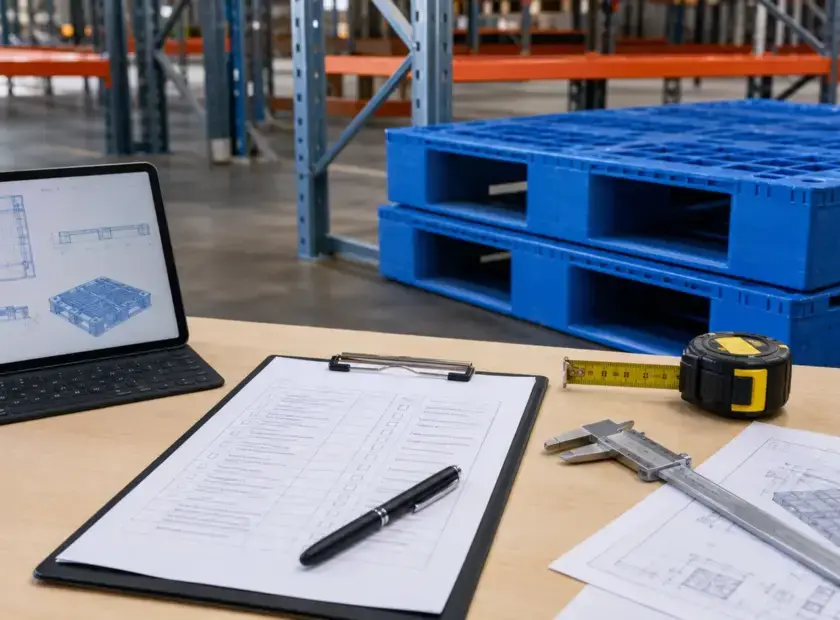
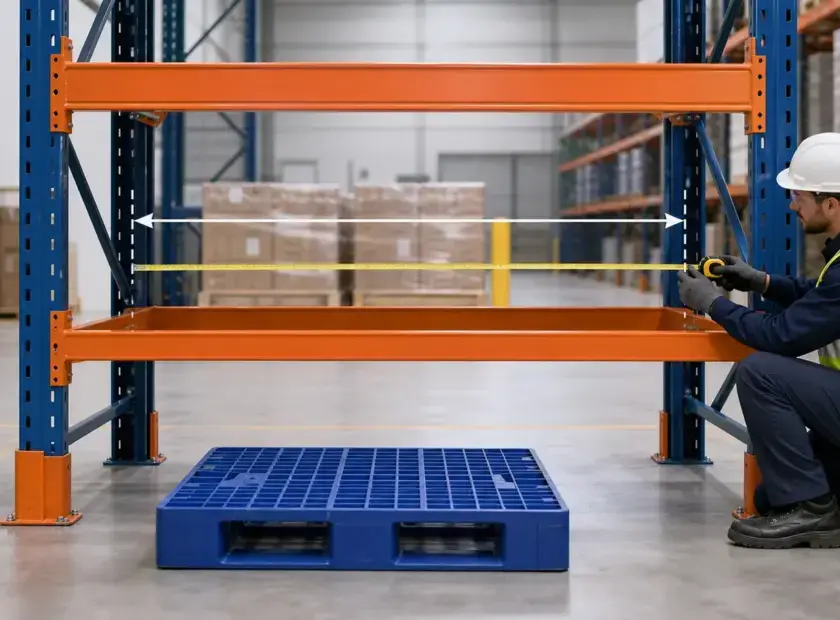
A plastic pallet can look serviceable from across an aisle while still having damage that affects handling, load support, or rack compatibility. A useful inspection therefore needs to be close, consistent, and tied to the pallet’s intended application.
The UK Health and Safety Executive recommends that pallets be inspected every time they are used and that damaged pallets be marked, isolated, and withdrawn for repair or disposal. For plastic pallets specifically, its guidance highlights cracks, mechanical damage, defective decks or bases, worn or permanently deformed supports, trapped debris, ultraviolet degradation, surface deposits, and permanent distortion.
This checklist turns those principles into a practical warehouse routine. It is not a substitute for the pallet manufacturer’s criteria, a site risk assessment, or an application-specific engineering review.
When should a plastic pallet be inspected?
A brief pre-use check should happen before each use, not only after an incident. Add a more detailed documented inspection at intervals determined by the facility’s risk assessment, pallet manufacturer, application, handling frequency, and operating environment.
Inspect a pallet again whenever:
- It has been dropped, struck, jammed, or mishandled
- A forklift tine or pallet-jack wheel has contacted the deck or base
- The load has shifted, leaked, overheated, frozen, or been exposed to chemicals
- The pallet returns from a customer, carrier, pool, or uncontrolled location
- It has spent extended time outdoors or in an unusually hot or cold area
- It will be reassigned to a different load, rack, conveyor, or automated system
- An operator notices unusual movement, noise, deflection, or poor fork entry
Inspection frequency should increase where the consequence of failure is higher, such as elevated rack storage, automated handling, concentrated loads, cold environments, or operations with frequent impacts. Do not invent a universal calendar interval; document why the chosen frequency suits the site and application.
Prepare a safe inspection area
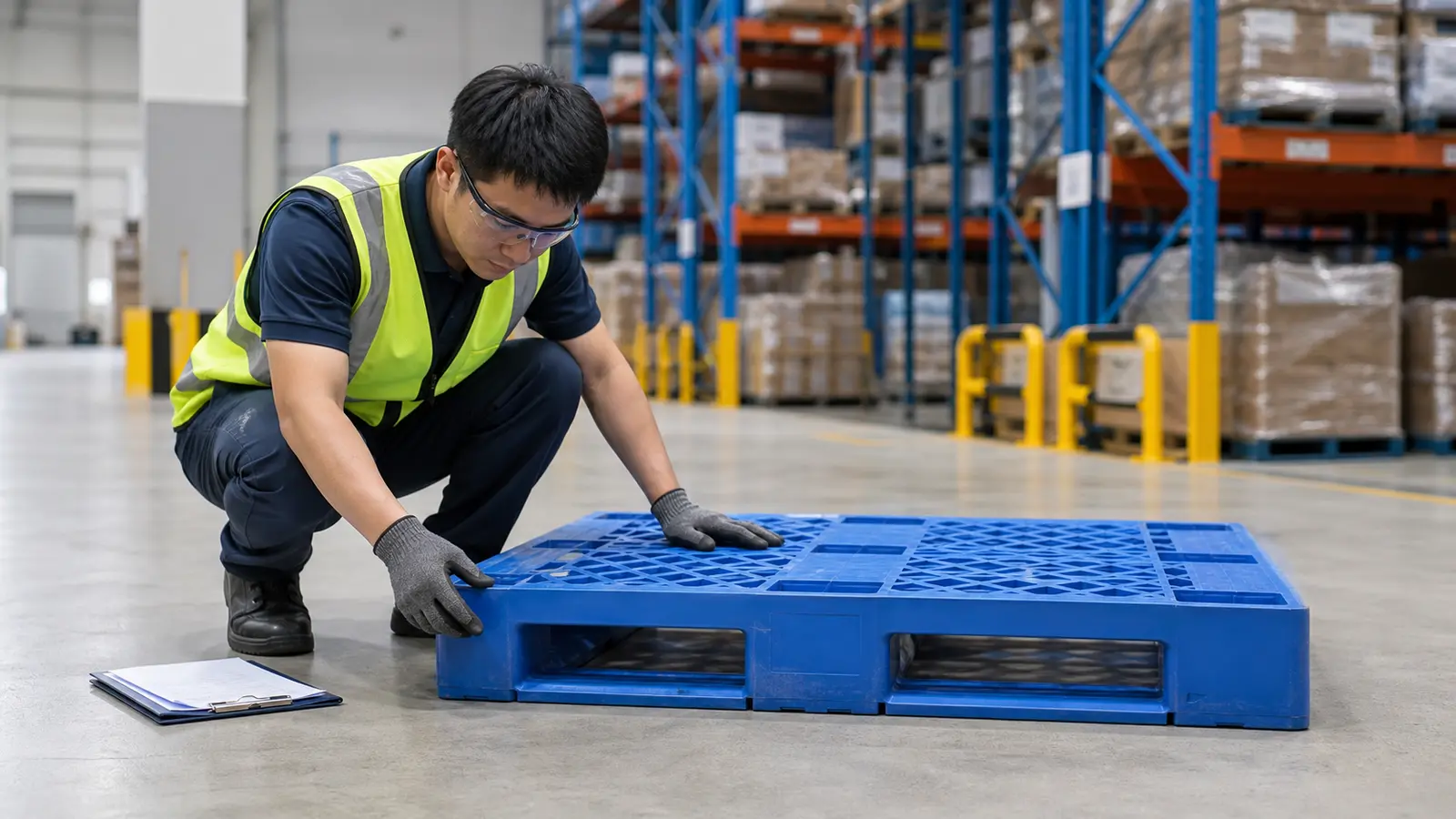
Inspect empty pallets at floor level in a well-lit area separated from moving equipment. Follow the facility’s traffic-control, personal protective equipment, manual-handling, lockout, and housekeeping procedures. Do not climb a rack, stand on a pallet, or reach beneath a suspended load to inspect it.
Remove loose stretch wrap and other packaging only when it is safe to do so. Clean enough dirt from the pallet to see the surfaces and joints, but follow the manufacturer’s cleaning instructions and the site’s controls for chemicals or contamination. If the pallet cannot be inspected safely or completely, place it in the hold area rather than returning it to service.
Plastic pallet inspection checklist
Use the same sequence every time so that difficult-to-see areas are not skipped. Compare the pallet with an undamaged example, approved drawing, data sheet, or manufacturer-issued inspection standard when one is available.
1. Confirm identity and intended use
- Identify the pallet model, owner, pool, or asset number where applicable.
- Confirm that its dimensions, entry pattern, and design match the planned load and handling method.
- Check that required identification and application markings remain legible.
- Do not substitute an unidentified pallet because its outside dimensions appear similar.
A pallet approved for floor storage is not automatically approved for unsupported rack storage. Before elevated use, confirm the model, load, orientation, rack type, and support condition. The guides to what makes a plastic pallet rackable and measuring pallet rack beam spacing explain the application details that need to be documented.
2. Check the top deck and load-contact surface
- Look for cracks, splits, punctures, gouges, missing material, or broken deck sections.
- Check for areas softened, blistered, melted, embrittled, or otherwise changed by heat, cold, or chemicals.
- Look across the surface for permanent bowing, twisting, sagging, or unevenness.
- Inspect anti-slip surfaces, plugs, grommets, and inserts for damage or loss.
- Check for contamination, sharp projections, trapped material, or residues that could affect the load.
Pay special attention to the points where concentrated loads sit. Drums, bins, feet, and machinery can apply force to a much smaller area than evenly distributed cartons.
3. Inspect corners, edges, and fork-entry openings
- Check all corners for impact damage, crushing, cracking, or missing sections.
- Inspect fork-entry openings for gouges, torn edges, punctures, and deformation.
- Look for polished, whitened, or stressed areas that may indicate repeated contact.
- Confirm that fork pockets remain clear and have not narrowed or distorted.
- Check that there are no loose pieces that could detach during handling.
Fork-entry damage is easy to miss because the visible deck may still appear flat. Use adequate light and view each opening from both sides when the pallet design permits.
4. Turn the pallet safely and examine the base
Use the site’s approved handling method to expose the underside. Do not improvise a lift or put hands beneath an unstable pallet.
- Inspect runners, skids, feet, stringers, and perimeter bases for cracks and wear.
- Look for permanent bending, twisting, flattening, or uneven support points.
- Check weld lines, molded joints, fasteners, and replaceable components where fitted.
- Inspect hollow supports for trapped debris, liquid, ice, or internal damage.
- Check the areas contacted by pallet-jack load wheels and conveyor rollers.
Base components are structurally important during lifting, conveyor movement, stacking, and some rack configurations. Surface damage should not be dismissed merely because it is on the underside.
5. Look for cracks, stress whitening, and material change
Examine high-stress transitions around openings, ribs, corners, reinforcement points, and deck-to-base connections. Flexing the pallet to reveal a crack should be done only if the manufacturer has issued a safe inspection method; otherwise use visual inspection and escalate uncertainty.
Color change can have several causes. Fading after outdoor exposure, white or dusty deposits, chalking, and localized whitening should be documented and referred to the manufacturer or pallet owner. HSE guidance says faded plastic pallets should be referred for manufacturer advice and pallets showing white, dusty surface deposits should be rejected.
6. Check reinforcement and fitted components
Some rackable plastic pallets contain steel bars, rods, or other reinforcement. Check accessible areas for displaced end caps, exposed metal, corrosion staining, loose components, rattling, bulges, or separation around the reinforcement channel. Do not drill, cut, heat, or dismantle a pallet to inspect hidden reinforcement unless the manufacturer has authorized a procedure.
Also inspect RFID housings, tracking tags, plugs, clips, anti-slip inserts, and other fitted parts. A missing accessory may affect identification, hygiene, handling, or compatibility even when the main body is intact.
7. Assess cleanliness and contamination
- Identify visible product residue, oil, grease, chemicals, biological material, or foreign objects.
- Check cavities, ribs, drain holes, and hollow supports for trapped material.
- Confirm that the pallet can be cleaned using an approved method for its material and application.
- Segregate pallets with unknown contamination until the responsible safety or quality team evaluates them.
Do not describe a pallet as hygienic, food-safe, or suitable for a regulated application solely because it is plastic. Suitability depends on the exact material, construction, condition, cleaning process, previous use, and applicable site or regulatory requirements.
8. Check overall shape on a flat surface
Place the empty pallet on a known flat surface where this can be done safely. Look for rocking, a lifted corner, diagonal twist, bowed runners, or permanent deck sag. Measure only against manufacturer-issued limits or an approved site standard.
Do not force a distorted pallet flat with a load or assume that racking will correct it. Permanent deformation can change fork entry, conveyor contact, stack stability, bearing on rack supports, and load distribution.
Defects that require immediate isolation
Remove the pallet from normal circulation when an inspection finds a crack, break, puncture, missing structural material, defective deck or base, worn or permanently deformed support, exposed reinforcement, serious contamination, permanent distortion, or another condition outside the manufacturer’s acceptance criteria.
Also isolate the pallet when:
- Its identity or approved application cannot be confirmed
- The inspector cannot see or access a critical area
- There is uncertainty about chemical, heat, cold, ultraviolet, or impact exposure
- Someone has made an undocumented repair or modification
- The pallet behaves differently from known serviceable pallets
Uncertainty is a reason to escalate, not a reason to approve. OSHA requires stored materials to be stable and secure against sliding or collapse. A questionable pallet should not be used as the foundation for an elevated or stacked load while its condition is unresolved.
Mark, isolate, and document the pallet
Create a clearly identified hold area that prevents a rejected pallet from being selected accidentally. Attach a durable hold tag or use the site’s asset system without covering evidence needed for evaluation.
A useful defect record includes:
- Date, time, location, inspector, and pallet identifier
- Pallet model, owner, and intended application if known
- Defect location and plain-language description
- Photographs from an overview and close range
- Known load, rack, handling, impact, temperature, or chemical exposure
- Immediate action taken and the person responsible for disposition
Trend the records by defect type and location. Repeated fork-pocket damage may indicate an entry or training issue; recurring runner damage may point to pallet-jack wheels or conveyor spacing; repeated distortion may require a review of load distribution, storage duration, temperature, or support conditions.
Repair, return, recycle, or dispose?
Do not improvise a structural repair with screws, wire, heat, adhesive, welding, or replacement material. A repair should restore the pallet to its approved specification and should be performed only under the pallet manufacturer’s, pallet owner’s, or another authorized repair program’s instructions.
Pooled or branded pallets may remain the property of another organization and should be handled through that owner’s process. For other pallets, the responsible owner should decide whether to return, professionally repair, recycle, or dispose of the unit based on documented criteria. Keep rejected pallets segregated until that decision is completed.
Build the checklist into daily operations
A checklist works only when employees know what to look for and have authority to stop a questionable pallet. Train receiving, warehouse, production, maintenance, quality, and lift-truck personnel on the pallet models they encounter and the site’s hold process.
Use photographs of approved and rejected examples, but do not let a photo library replace manufacturer criteria. Audit the hold area, review defect trends, and update the routine when loads, rack systems, conveyors, temperatures, cleaning methods, or pallet models change.
Questions to include in a pallet condition review
When asking a pallet supplier, manufacturer, owner, rack provider, or qualified professional to assess a pallet program, provide the defect records and ask:
- Which components are structurally critical for this model and application?
- What visible conditions require immediate removal from service?
- Are dimensional or deformation limits available for trained inspectors?
- Can this model be repaired, and who is authorized to perform the work?
- Do cold, heat, chemicals, outdoor exposure, or wash processes change the criteria?
- Does rack, conveyor, or automation use require additional checks?
- How should rejected units be returned, recycled, or disposed of?
The plastic pallet FAQ and material handling glossary provide supporting terminology for an internal inspection procedure.
Request an application review
To discuss a rackable plastic pallet application, contact the team with the pallet model or required dimensions, rack support details, maximum unit-load weight and distribution, handling equipment, storage duration, temperature range, and any recurring damage observations. Clear application information supports a more useful review than dimensions or capacity alone.
Safety note: This article is a general inspection framework, not a manufacturer acceptance standard, engineering approval, or site-specific safety procedure. Follow applicable regulations, the pallet and equipment manufacturers’ instructions, and your facility’s risk assessment.