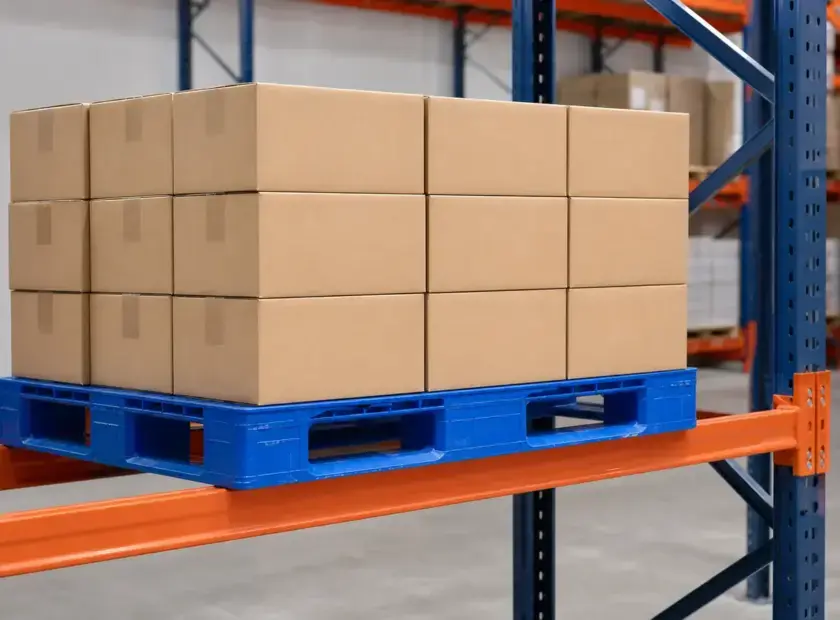
A plastic pallet can look strong on a warehouse floor and still be the wrong pallet for storage in a rack. The difference is support. On the floor, nearly the entire underside may be supported. In a selective rack, the pallet may bridge an open span between two beams while carrying a load for hours, days, or longer.
That is why the word rackable should never be treated as a generic synonym for heavy-duty. A rackable plastic pallet is a pallet whose design and tested load rating match a defined rack-support condition. The pallet, load, rack geometry, handling method, temperature, and storage time all affect whether the application is appropriate.
This guide explains the terms buyers should verify before placing a plastic pallet in elevated storage.

What does “rackable” mean?
A rackable pallet is designed to support a specified load while spanning between rack supports. In practice, the rating is only meaningful when the test or specification states how the pallet was supported. Two common conditions are:
- Edge-rack support: the pallet rests on two rack beams or rails near opposite edges, leaving most of the pallet unsupported.
- Full-perimeter or additional support: the pallet is supported by a deck, wire mesh, closely spaced bars, or another structure that reduces the unsupported span.
The same pallet can behave very differently in those two conditions. A capacity stated for full support should not be assumed to apply to edge-rack storage. Likewise, a rating based on one beam spacing or load pattern may not transfer to a different rack layout.
International pallet testing is formalized in the ISO 8611-1:2025 test methods for flat pallets. The standard distinguishes tests used to evaluate nominal load, maximum working load, and durability. That distinction matters: there is no single universal “pallet capacity” that describes every handling and storage condition.
Rackable load is not the same as static or dynamic load
Pallet specifications commonly list several capacities. They describe different support and handling conditions:
- Static load: the load a pallet can carry while resting on a flat, fully supporting surface.
- Dynamic load: the load associated with lifting and moving the pallet, typically with a forklift or pallet jack under stated conditions.
- Racking load: the load the pallet can carry while bridging a stated rack-support arrangement.
The static number is often the largest because the floor supports the pallet broadly. The racking condition is usually more demanding because the pallet must resist bending across an open span. Never substitute a static or dynamic rating for a racking rating.
Even a published racking number needs context. Ask whether it assumes a uniformly distributed load, what beam spacing was used, how long the test lasted, and what deflection limit or safety factor was applied. Concentrated loads, such as a dense machine component placed in the center, can create stresses that are not represented by a uniform-load rating.
How pallet design affects rack performance
Deck and runner geometry
The top deck distributes the unit load into the pallet structure. Runners, stringers, or a perimeter base then transfer that force toward the rack supports. Their depth, shape, spacing, and connection to the deck influence stiffness. A pallet designed mainly for floor stacking or one-way shipping may have adequate fork access but insufficient stiffness for an unsupported rack span.
Reinforcement
Some rackable plastic pallets use steel or composite reinforcement inside the deck or runners. Reinforcement can increase stiffness, but its presence alone does not establish a safe capacity. The relevant evidence is a rating for the complete pallet design under the intended support condition.
Material and temperature
Plastic behavior changes with material formulation, temperature, load duration, and previous use. Under a sustained load, plastic can continue to deform over time, a behavior commonly called creep. A short-duration result therefore should not be treated as proof for long-term elevated storage unless the manufacturer’s data addresses that use.
Cold rooms, freezers, hot environments, wash cycles, and outdoor exposure can also affect performance. Buyers should provide the expected temperature range and storage duration when requesting a recommendation.
Condition and history
A rating for a new pallet does not erase damage or wear. Cracked runners, damaged welds, deep cuts, permanent bowing, missing reinforcement, or chemical attack can change how a pallet carries load. Used pallets require inspection and traceability to the correct model and specification.
The rack and the pallet must be evaluated together
Rack compatibility is not determined by pallet size alone. The following dimensions and conditions should be confirmed:
- Clear distance between the supporting beam faces
- Required pallet overhang at the front and rear
- Beam width and profile
- Presence and position of pallet supports, wire decking, or safety bars
- Rack type, including selective, drive-in, push-back, pallet-flow, or another system
- Fork-entry direction and how the load will be placed
- Available clearances around the load and rack structure
The rack itself must be designed, installed, used, and maintained for its loads. The Rack Manufacturers Institute guidance is a useful starting point for rack-system questions, while the pallet supplier should address the pallet’s tested support condition. When an application is unusual or the consequences of failure are significant, involve the rack manufacturer or a qualified engineer.
Load distribution changes the answer
A rating based on a uniformly distributed load assumes the weight is spread across the deck in a defined manner. Real unit loads may be less cooperative. Drums, liquid totes, machinery, stacked pails, and products with small feet can create concentrated forces. Cartons may also shift or become unevenly stacked.
Before choosing a pallet, document:
- Total unit-load weight, including packaging and the pallet
- Number, size, and position of contact points
- Whether the load can shift during transport or storage
- Load height and center of gravity
- Whether stretch wrap, strapping, corner boards, or other stabilization is used
OSHA’s material-storage rule requires stored materials to be stable and secure against sliding or collapse. See 29 CFR 1910.176. A pallet capacity number is only one part of meeting that broader responsibility.
A practical rackable pallet selection checklist
- Identify the exact rack configuration. Record rack type, beam spacing, support surfaces, and pallet orientation. Photographs and dimensioned drawings reduce ambiguity.
- Define the real unit load. Include maximum weight, distribution, footprint, center of gravity, and any concentrated contact points.
- Separate the capacity terms. Request static, dynamic, and racking ratings individually. Do not accept one number presented as suitable for all conditions.
- Ask for the racking test condition. Confirm support spacing, load distribution, test method, duration, temperature, deflection criteria, and whether the value is a maximum or recommended working load.
- Confirm environmental limits. State the minimum and maximum temperature, storage duration, wash process, chemical exposure, and indoor or outdoor use.
- Verify handling compatibility. Confirm fork and pallet-jack entry, conveyor use, automated equipment, and any required anti-slip features.
- Establish inspection rules. Define what damage removes a pallet from service and who is responsible for inspection.
- Validate the combined system. Confirm that the pallet recommendation and rack design are compatible before elevated storage begins.
Questions to ask a pallet supplier
A useful request for quotation should ask for evidence, not just a capacity claim:
- Is this exact pallet model rated for my rack-support condition?
- What unsupported span and support orientation does the rating assume?
- Is the load uniformly distributed, and what concentrated-load limits apply?
- Does the rating address the intended storage duration and temperature?
- What deflection should be expected at the recommended working load?
- Does the pallet contain reinforcement, and are there inspection points for it?
- What damage or deformation requires removal from service?
- Can you provide the applicable test method or technical data sheet?
Common mistakes to avoid
- Using the static capacity as the rack capacity
- Assuming every heavy-duty plastic pallet is rackable
- Ignoring the difference between edge support and deck support
- Applying a uniform-load rating to a concentrated load
- Changing beam spacing without rechecking the pallet specification
- Using a damaged or unidentified pallet because an undamaged version was rated
- Relying on a capacity number that does not name a test or support condition
The bottom line
A plastic pallet is rackable only for the conditions its design and evidence support. The safest buying process starts with the rack geometry and real unit load, then matches those facts to a clearly documented racking rating. Static capacity, appearance, or reinforcement alone are not enough.
For more terminology, visit the material handling glossary and plastic pallet FAQ. To discuss an application, review the site’s rackable plastic pallet overview and contact the team with your rack dimensions, load details, handling method, and environment.
Safety note: This article provides general selection guidance. Final pallet and rack suitability should be confirmed for the specific application by the relevant manufacturers or a qualified professional.